Rescuers: Stories Of Courage: Two Families Movie Download
In 2019, Arthur, the long-running PBS series nigh an anthropomorphic, school-anile aardvark, aired an episode chosen "Mr. Ratburn and the Special Someone." Colloquially, information technology became known as the "Gay Rat Wedding" episode, and information technology received a swell of support from queer fans, allies and organizations like GLAAD. Nonetheless, fifty-fifty as recently as two years ago, that episode as well faced immense backlash from homophobic detractors for portraying a queer wedding — for beingness inclusive.
But this wasn't the first time the show depicted LGBTQ+ folks. Back in 2005, Arthur first faced backlash due to a spin-off episode, "Postcards From Buster." In it, Arthur'southward rabbit pal, Buster, visited actual (live-action) families — and ane of those families happened to be a lesbian couple from Vermont. The public outcry was then huge that the then-U.S. Secretary of Education demanded PBS return the public funds information technology used to create the episode. And that was just 16 years agone.
"Until very recently, LGBTQ+ people would look to media and not have whatsoever representation or would only have a negative stereotype to identify with," wrote Apr Sizemore-Barber, a professor in the women'south and gender studies program at Georgetown University. "This absence of stories leads to ignorance among members of the general public [who don't see LGBTQ+ stories represented] and isolation for those who identify as LGBTQ+ and are implicitly told that they don't be."
In animation, for case, Disney has a long history of queer-coding its villains; even today, the studio reduces queer characters into blink-and-you-miss-it scenes, often played for laughs. So, yes, it'due south clear that a lot of piece of work needs to be done. And a lot of that work falls on the folks who are green-lighting shows and films.Arthur's one-off episode, for example, tin help normalize queer families, but shows likeSteven Universe andKipo and the Age of Wonderbeasts are moving the punch even further on a more regular basis.
So, what tin can nosotros do as audiences to support queer and trans creators and their LGBTQ+-inclusive narratives? We tin can spotter them — all twelvemonth round. Then, whether you're looking to celebrate Pride Month, diversify your kids' media intake twelvemonth-round, or find positive representation for queer and trans kids who want to see themselves reflected in queer characters and stories, check out these must-sentinel Idiot box shows and films that center queerness.
Animated Goggle box Series
Steven Universe
Created by Rebecca Sugar for Cartoon Network, Steven Universe tells the coming-of-age story of the titular boy (Zach Callison). Although Steven'southward dad is a machine wash-owning rock musician, his mom, Rose Quartz, was a gem — a magical, humanoid alien from outer space. Years ago, Rose led the Crystal Gems, a rebel grouping, in a state of war to protect World from her conflicting Homeworld, which sought to colonize Earth and strip it of its resources. When she gives nascency to Steven, Rose passes on her powers and life-force, leaving the other members of the Crystal Gems — Garnet (Estelle), Amethyst (Michaela Dietz) and Pearl (Deedee Magno Hall) — to raise Steven and protect Earth in Rose's stead.
This decidedly queer Peabody Honour-winning show is often hilarious and fun, but it also speaks to the importance of chosen family and how to class healthy interpersonal relationships. While in that location's a lot of bang-up LGBTQ+ representation, it's worth pointing out a few characters in particular. In guild to get stronger, Steven Universe's Gem characters can fuse together when needed. Merely Steven, our half-Gem and half-human protagonist, has the uncanny power to fuse with his human friend, Connie Maheswaran (Grace Rolek). Together, the duo brand up Stevonnie. In addition to using gender-neutral pronouns, Stevonnie shared in a Cartoon Network PSA that they are not-binary and intersex.
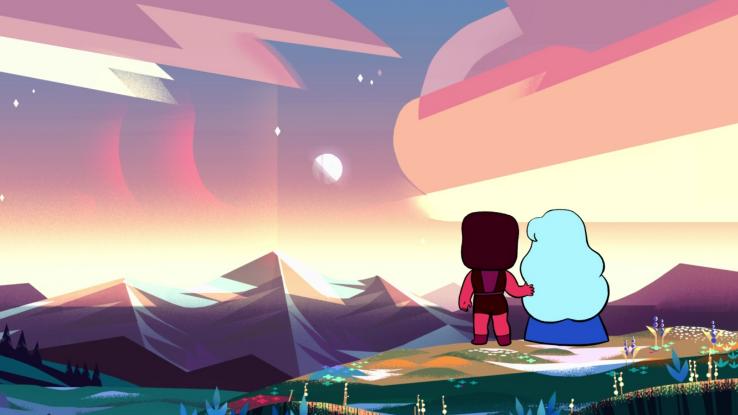
Other history-making characters include Ruby and Sapphire, the 2 Gems who fuse to make Estelle's Garnet. Nevertheless, instead of fusing temporarily, Reddish and Sapphire remain Garnet (almost always) as an expression of their love. Saccharide, the creator and showrunner, has said that the "Gems are all nonbinary women… They're coded female… They wouldn't think of themselves as women, just they're fine with being interpreted that way amidst humans." In a 2018 episode, Scarlet asks Sapphire to marry her, marking the first aforementioned-sexual practice proposal in mainstream children's TV — which, of course, was followed by a groundbreaking wedding episode.
Blue's Clues
To gloat the commencement of Pride Month, Nickelodeon'due south long-running Bluish's Clues hosted an incredibly intersectional virtual Pride parade. Drag Race contestant Nina West hosted the parade — in drawing class, of course — by singing a tune that celebrated the various families in attendance. "When a drawing elevate queen leads me on a three-minute journey through the magic of embracing the queer family in all of its multifaceted glory, who am I to say no?" writes BuzzFeed'southward Mary Colussi — and we couldn't concur more than. Without a doubt, Nick Jr.'s landmark parade is a great style to introduce youngsters to diverse LGBTQ+ identities and families.
The Owl House
It'southward no secret that Disney's large-screen representation has been sorely lacking. In addition to queerbaiting fans, Disney has used the promise of on-screen representation to garner buzz for their films, and, in the end, that buzz amounts to nothing much. In the live-action remake of Beauty and the Beast (2017), queerness was played for laughs. 2 years later, in Avengers: Endgame (2019), an unnamed, inconsequential man mentions going on a date with another homo. And, that same yr, in Star Wars: Episode IX – The Rise of Skywalker, two women share a truly glimmer-and-you-miss-it celebratory osculation; in that same scene, even a Resistance member embracing a infinite slug gets more than onscreen visibility.
While we wish the company was as enthusiastic about queer protagonists as Raya and the Last Dragon star Kelly Marie Tran, there'southward some hope in the form of Disney Aqueduct's The Owl House. Disney'south first queer animated lead appearing on Television receiver instead of in a theatrical release isn't surprising; although the prove has been banned in several countries due to its LGBTQ+ representation, its success doesn't hinge on box office draw.
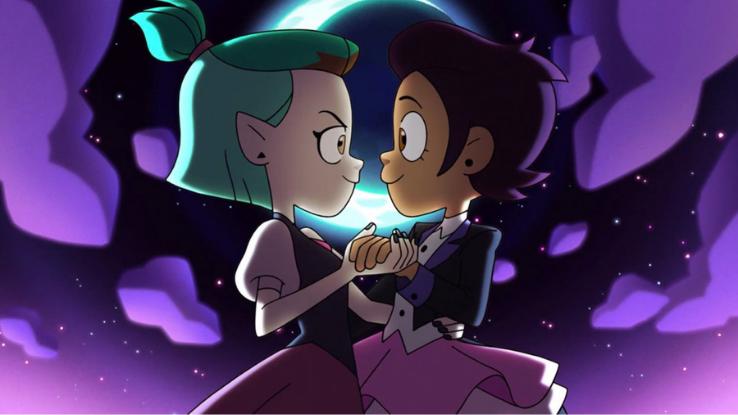
Regardless of the corporation'south messy rails record, nosotros dearest The Owl Business firm. The prove centers on Luz Noceda, a human teenager who stumbles through a portal to another (more magical) earth and becomes a witch's apprentice. Since its debut, the GLAAD Media Honor-nominated show has received praise for featuring several LGBTQ+ characters — and for depicting a romance between Luz, who creator Dana Terrace has confirmed is bisexual, and the prodigious young witch and lesbian Amity Blight.
She-Ra and the Princesses of Power
Created by Eisner Award-winning comic writer/artist Noelle Stevenson (Nimona, Lumberjanes), She-Ra and the Princesses of Power is a reboot of the 1985 series She-Ra: Princess of Power — a spinoff of He-Homo and the Masters of the Universe. The series' protagonist is Adora, a teenager who trained aslope her then-friend Catra in the Lord Hordak's (evil) Horde army.
In the airplane pilot, Adora gains the power to turn herself into the show's titular heroine and, together with a group of other magical princesses, vows to defeat Hordak. The show is full of queer characters, including a nonbinary, shapeshifting character named Double Problem (Jacob Tobia) and Spinerella and Netossa, two queer women in a aforementioned-sex relationship. Additionally, the Emmy- and GLAAD Media Honor-nominated prove has been praised for taking on difficult topics, such as the circuitous best friend-turned-archenemy relationship between Adora and Catra, which — spoiler alert! — culminates in a very articulate, and very queer, declaration of love in the show'south contempo concluding season. With a diverse cast and a great mix of action, humor and feels, She-Ra is an ballsy romp you won't desire to miss.
Kipo and the Historic period of Wonderbeasts
Kipo and the Age of Wonderbeasts is Netflix's under-the-radar gem you should be watching — for many reasons. One of those reasons? It treats coming out similar any other function of life. It isn't the source of drama or tension; instead, it's a sweet moment shared betwixt friends. Created by Radford Sechrist, the testify tells the story of Kipo Oak, who traverses a mail service-apocalyptic land in search of her father. On her journey, she befriends both man and mutant creature pals.
When Kipo tells Benson, one of her homo friends, that she likes him, he shares that he likes her as a friend because he's gay — and he actually says the words, "I'm gay." Writing for Polygon, Petrana Radulovic notes that the scene is "a first for all-ages animation," because even on shows like She-Ra or Steven Universe, characters don't declare their queerness. "One could argue that information technology'southward a matter of showing and not telling," Radulovic points out, referring to the way queer characters on other shows just are, no declarations needed. "…merely in that location'southward a different consequence to a graphic symbol proclaiming 'I'g gay,' let lone a lead graphic symbol." The series likewise features Asher, a non-binary character, and Troy, a gay character who's crushing on Benson just as much as Benson's burdensome on him.
Young Justice
Rounding out our picks is DC Comics' Young Justice, which features Halo. A fusion of Gabrielle Daou, a deceased Quraci girl, and the spirit of a Motherbox, or "living computer," Halo joins Nightwing'southward team of heroes. Halo doesn't view themself equally Gabrielle anymore, instead going by the pseudonym Violet Harper, and, while they don't explicitly use the term "non-binary" at first, they do announce that they don't know if they are a boy or a girl when misgendered by a teammate.
Although shows like Young Justice and Arthur aren't as lauded for their representation as some of the other entries on our list, these storylines and characters do reverberate changing norms, not just in children's programming, but in society at large — and that'southward incredibly meaningful.
Feature-Length Films
Adventure Fourth dimension: Distant Lands — Obsidian (2020)
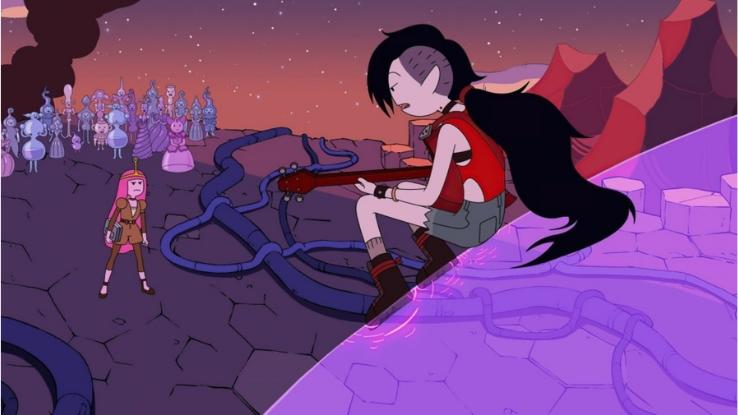
For years, Adventure Fourth dimension's Princess Bubblegum (Hynden Walch) and Marceline the Vampire Queen (Olivia Olson) had some subtextual romance brewing. In fact, it was strongly implied both in the show and in spin-off comics that the two were exes. After countless adventures, a lot of very sweet sentiments, and 10 long seasons, the duo finally cemented their romance onscreen with a buss in the series' finale.
More recently, the couple starred in "Obsidian," a feature that'south one of HBO Max's four Risk Time: Distant Lands specials. In addition to filling in the gaps in the couple's long history, "Obsidian" packs an emotional punch and serves up some great new tunes. Best of all, it turns all that subtext we'd poured over for years into indisputable catechism. Writing for The A.V. Club, William Hughes calls it "fan service at its finest."
The Half of Information technology (2020)
Saving Face (2004) marked Alice Wu'southward directorial debut and, honestly, a filmmaker couldn't enquire for a improve kickoff outing. Now, over a decade after, Wu released her sophomore characteristic, The One-half of It, on Netflix to corking acclaim. Pitched as a "different kind of love story," The Half of It is a loose retelling of the Cyrano de Bergerac story — with a queer twist. Or what Rolling Stone describes as a "quietly revolutionary accomplishment…brimming over with pleasures of the unexpected."
Ellie Chu (Leah Lewis) lives in the small town of Squahamish, and she spends her time writing papers for her peers in commutation for money and handling her dad's station master and signalman duties at the town'due south train terminate. When she meets Paul Munsky (Daniel Diemer), a well-significant but inarticulate jock, Ellie writes messages on Paul'due south behalf to Aster Flores (Alexxis Lemire), his beat — and, equally it turns out, Ellie's vanquish, too. While it was marketed (in part) equally a YA rom-com, the film is more than longing than first romances, but information technology still feels refreshing. After all, as Lewis points out, "[i]t'due south a cocky-dear story… [the characters] end up with something… It is a love story, it's just not a 'romance' story."
The Mitchells vs. the Machines (2021)
Released in select theaters and on Netflix in April 2021, The Mitchells vs. the Machines has been warmly received by critics and audiences alike — and deservedly then. The moving-picture show centers on Katie Mitchell (Broad City'due south Abbi Jacobson), an cocked, outsider teen with a talent for making brusk films. After feeling "weird" her whole life, Katie can't await to head to college in California; even her group conversation with her soon-to-be filmmaker classmates is labeled "My People."
The merely problem? Katie'south outdoorsy dad, Rick (Danny McBride), doesn't quite get her — nor does he understand Katie's films or the way she finds community through technology. After a male parent-daughter fight on Katie's concluding dark domicile, Rick decides to cancel Katie'due south flight and accept the family on one concluding road trip. But, as fate would accept it, Mark (Eric André), the founder of the tech company PAL, a kind of Amazon/Apple combo, accidentally triggers the robot apocalypse. This leaves the dysfunctional Mitchell family unit — which is rounded out by Katie'southward mom, Linda (Maya Rudolph); Katie'due south dinosaur-loving brother, Aaron (Michael Rianda); and the family dog Monchi (Doug the Pug) — to save the world.
The Mitchells vs. the Machines is also visually stunning: each frame is packed with so much detail and takes inspiration from Katie's journaling and cobbled-together short film artful, giving it a personal (and appropriately corybantic) feel. All-time of all, the team backside the film have worked on standout blithe fare, similar Gravity Falls and Spider-Human: Into the Spider-Poesy (2018), then you lot know at that place will be a lot of heart and some sharp humor. Plus, Katie is queer — and, by the end of the moving-picture show, has a potential girlfriend — but, thankfully, none of the drama or heartache revolves effectually her coming out or identity.
Coming Shortly to Netflix:The Witch Boy (TBA, 2021)
Based on Molly Knox Ostertag's graphic novel series of the same proper name, The Witch Boy is set to exist a landmark animated musical. The story follows Aster, a young boy who discovers he'southward a witch — even though, in his world, just girls inherit witchy powers, while boys are meant to exist shapeshifters. To protect his secret, magical community and learn more about himself, Aster sets off on a journey of discovery.
Directed by Minkyu Lee (Adam and Canis familiaris, Dear Basketball, Big Hero half-dozen) and featuring original music from Grammy-nominated band HAIM (equanimous of sisters Este, Danielle, and Alana Haim), The Witch Boy is shaping up to be ane of the most hotly anticipated (and original) animated films of the year. "My promise is that this picture, by celebrating queerness and otherness,' will come to audiences around the world as something truly special," Lee said.
Books for Younger Readers
The Boy & the Bindi past Vivek Shraya with Illustrations by Rajni Perera
Canadian musician, author, visual creative person and Tegan and Sara Foundation board member Vivek Shraya'due south showtime book, God Loves Hair, was nominated for a Lambda Literary Award in the YA category. Centered around the life of a dark-brown, genderqueer child growing up in an immigrant family in Alberta, the book is composed of illustrated, linked stories. Several years afterwards, The Boy & the Bindi marks Shraya's first foray into writing a children'due south picture volume.
Illustrated by Rajni Perera, the volume is almost a young boy's obsession with his female parent'southward bindi — "a colored dot worn on the center of the brow," originally by folks from Bharat who exercise Hinduism and Jainism — and his desire to wear a bindi, too. The School Library Journal praised the volume, noting, "With gentle rhymes and warm whimsy, amplified by Toronto artist Perera's richly hued illustrations… [Shraya], a transgender woman, deftly explores difference and self-acceptance, the subversion of gender expectations, and the power of 'making sure I don't hibernate/Everything I am within.'"
The Frog and Toad Books by Arnold Lobel
While these sweet stories about two tweed-wearing amphibians aren't explicitly queer, and while nosotros'd normally champion works that go beyond subtext, there'due south something special about Arnold Lobel'due south Frog and Toad books. Published between 1970 and 1979, the stories were written amidst Lobel'due south ain personal revelation. "I call back Frog and Toad actually was the start of him coming out," Adrianne Lobel, the author'due south girl, told The New Yorker.
If Frog and Toad had been written nigh in a different time, their queerness probably would've been more than subtext, just it still resonates deeply. In fact, there's actually no heterosexual explanation for their dynamic. "What my partner and I have plant, though, is that in the pages of Lobel's queer love story, there is a blueprint for how to live and thrive every bit a queer couple," S.E. Fleenor writes in an essay for Electric Literature. "The honey characters are good role models for children in any number of ways, demonstrating positive ways of coping with feet, frustration, and colorlessness… I've also realized that they're the model of a queer human relationship I e'er needed."
Mythology-Based Books From the "Riordanverse"
Rick Riordan is best known for his chart-topping YA novel Percy Jackson and the Olympians, which tells the story of a young boy who discovers he's a demi-god — and then finds himself caught upwards in modern-day Greek mythology-inspired misadventures. Subsequently writing many a novel inspired by Greek mythology, Riordan pivoted to Norse mythology, which brings usa to Magnus Chase ii: The Hammer of Thor, which won a Stonewall Honor for queer representation.
After receiving the Stonewall, Riordan said in his credence speech, "And then, what is an quondam cis straight white male person doing up here? Where did I get the nerve to write Alex Fierro, a transgender, gender fluid kid of Loki in The Hammer of Thor, and why should I become cookies for that? These are all fair and valid questions, which I accept been asking myself a lot." Riordan went on to say because his queer readers desire to be part of the universe he's created, he felt responsible for creating some mainstream representation. "As important as it is to offer accurate voices and empower authors and role models from within LGBTQ community, it's also important that LGBTQ kids see themselves reflected and valued in the larger globe of mass media. …I will not erase you."
Long story brusque, cheque out Riordan'southward queer-inclusive fantasy novels. And check out his Rick Riordan Presents imprint, which leverages his platform to give more than visibility to #OwnVoices Percy Jackson-esque works well-nigh other cultures and mythologies — by authors with those bodily, lived experiences.
Stories for Young Adult (YA) Readers
Laura Dean Keeps Breaking Up With Me by Mariko Tamaki with Illustrations by Rosemary Valero-O'Connell
After working on projects like Curiosity's She-Hulk, DC Comics' Supergirl and Noelle Stevenson's queer comic Lumberjanes, writer Mariko Tamaki collaborated with artist Rosemary Valero-O'Connell for the hitting graphic novel Laura Dean Keeps Breaking Up with Me. Set in Berkeley, California, the book centers on Frederica, or Freddy, a 17-year-quondam biracial lesbian, and, as the title of the graphic novel suggests, she struggles with her on-again/off-again human relationship with "cool daughter" Laura Dean.
At starting time, the premise might seem like quirky rom-com forage, but it becomes a very real examination of a toxic relationship: Laura constantly gaslights Freddy, manipulates her, and fetishizes their relationship. At its cadre, Laura Dean is a story about finding i's ain self-worth and identity — of not letting others (or others' actions) define yous, which isn't something a lot of YA media tackles in such a head-on way. Additionally, Forbes author Rob Salkowitz wrote that Laura Dean's inclusion of a "depoliticized and unfussy delineation of gender-fluid teen culture in the 2010s" makes the graphic novel "a step frontward in LGBTQ graphic literature."
You Should See Me in a Crown by Leah Johnson
Author Leah Johnson has written an incredible debut novel — 1 that the publisher describes as "a smart, hilarious, Black girl magic, ain voices rom-com by a staggeringly talented new author." Chances are, if you haven't read You Should Run into Me in a Crown, you've at to the lowest degree seen other people reading this bonafide hitting (and presently-to-be archetype).
In the novel, Liz Lighty, who has "always believed she's also Black, too poor, likewise bad-mannered to shine in her small, rich, prom-obsessed Midwestern town," dreams of getting away by mode of an elite college with a world-famous orchestra — well, until her financial aid falls through. Subsequently realizing there's a scholarship available for prom queen and king, Liz has to endure the competition — and alluring new girl Mack — equally she navigates loftier school, relationships and settling into her own queerness and queer joy.
Felix Ever After by Kacen Callender
In Felix Ever After, Stonewall and Lambda Award-winning author Kacen Callender crafts a landmark YA novel about Felix, a transgender teen who fears that he'south "one marginalization too many — Black, queer, and transgender — to ever get his own happily e'er-after." When a transphobic student publicly posts Felix's deadname and photos on campus, our protagonist plots his revenge — and, throughout the course of the novel, navigates both cocky-discovery and a blossoming, unexpected first beloved.
Intricately plotted and beautifully written, Felix Always Afterwards is an essential read. In a starred review, Booklist notes that "[f]rom its stunning cover fine art to the rich, messy, nuanced narrative at its heart, this is an unforgettable story of friendship, heartbreak, forgiveness, and self-discovery, crafted by an author whose obvious respect for teen readers radiates from every page."
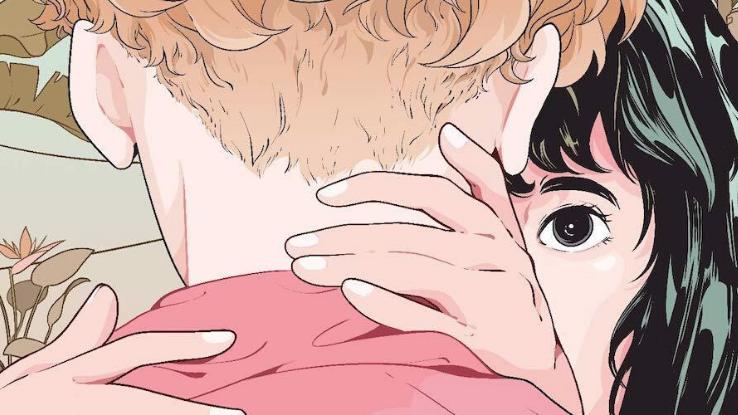
Cemetery Boys by Aiden Thomas
In this debut paranormal novel, Yadriel, a young trans male child, is determined to testify himself, and his gender, to his traditional Latinx family. This leads Yadriel to perform a ritual — one he hopes will help him find the ghost of his murdered cousin. Only things don't always get every bit planned, peculiarly when y'all're dealing with the supernatural. The ghost Yadriel really summons is Julian Diaz, the resident bad boy who has some loose ends to tie upward earlier he passes on. And the longer the ii boys work together, the more than Yadriel wants Julian to stay.
Early, Entertainment Weekly dubbed Cemetery Boys "groundbreaking" — and that couldn't be more than truthful. "It was […] really of import for me to write a book where LGBTQIA and Latinx kids could come across themselves being powerful heroes," author Aiden Thomas said in an interview. "Right now, these kids are living in a world where a lot of hate and suffering is zeroed in on them. I wanted them to see themselves being supported and loved for who they are. I wanted to write a fun book with good representation that they could escape into and have a happy catastrophe."
All Boys Aren't Blue: A Memoir-Manifesto by George Yard. Johnson
With what School Library Periodical calls "a conversational tone [that] will exit readers feeling like they are sitting with an insightful friend,"All Boys Aren't Blueish explores topics like gender identity, toxic masculinity, and Black joy. Penned by announcer and LGBTQIA+ activist George Grand. Johnson, these personal essays are, in part, so landmark — and so meaningful to queer Blackness readers in item — because we don't often encounter memoirs written specifically for young adults.
This tin can't-miss memoir-manifesto is also beautifully written — full of lovely linguistic communication and untold amounts of guidance and support. "This title opens new doors," Kirkus Reviews notes. "[…T]he author insists that we don't accept to ballast stories… to tragic ends: 'Many of us are nevertheless here. Nevertheless living and waiting for our stories to be told―to tell them ourselves.'"
Universes That Encompass Books, TV & Picture show
The Legend of Korra — and Other Avatar: The Last Airbender Spin-Offs
The Fable of Korra is the sequel series to Nickelodeon'southward beloved Avatar: The Last Airbender series. The original bear witness tells the story of Aang — a immature boy who tin can bend (or control) the four elements of fire, water, air and globe, considering he is the Avatar, a existence that's the bridge between the human and spirit worlds and who is destined to bring most balance. Aang is tasked with mastering the elements and saving the globe from a century-long war that'southward coming to a caput. In the sequel series, Korra, who is born the Avatar after Aang passes away, is tasked with carrying on that legacy and mastering the elements.
Like Aang, Korra gets by with a little help from her friends — namely Bolin, Mako and Asami. In the show's offset flavour, Korra crushes hard on Mako, but he and Asami cease upwardly being an item — well, until the finale, when he and Korra finally get together. While Korra and Mako don't last more than than a half flavor, the Avatar does cease upward finding true beloved.
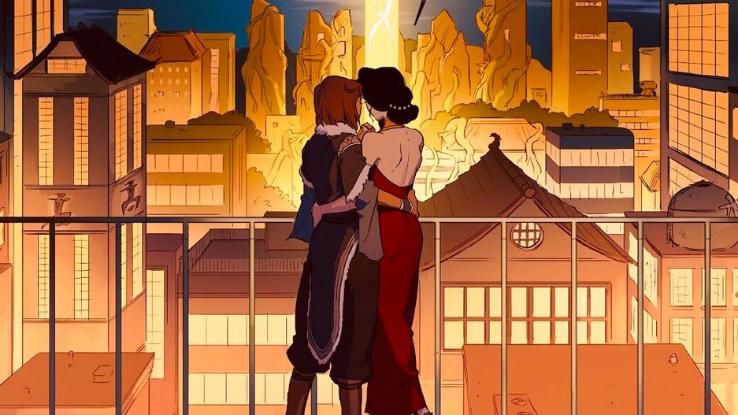
At the time, Korra'south series finale was a landmark moment for children's tv — and television in general. In the tertiary and quaternary seasons in particular, there seems to be a growing romantic tension between Korra and Asami — though fans, used to being allow down by queer rep in cartoons in general, felt the subtext wouldn't go beyond that. But, in the terminal few moments of the bear witness, the pair clasp easily and commence on a new journey together — just the ii of them. They almost osculation, but don't; Nickelodeon wasn't fix for that. Luckily, subsequent comic series, Turf Wars and Ruins of the Empire, accept gone on to flesh out the pair's romantic relationship.
Avatar fans should also bank check out the Avatar Kyoshi novels; written by F. C. Yee,The Rise of Kyoshi and The Shadow of Kyoshi trace the adventures of the Earth Kingdom-born titular Avatar — and, as we've known since the first Korra graphic novel, Kyoshi is also queer. "Folks who know what the canon is from Korra are going to exist looking for [Kyoshi's queerness to be represented in the books], and other readers might be learning for the outset time that a Kyoshi is bisexual in this novel," Yee told Polygon. "It felt really of import for me to include that and essentially do her relationships justice."
Becky Albertalli's "Simonverse"
Becky Albertalli'southward 2015 young adult (YA) novel Simon vs. the Homo Sapiens Agenda skyrocketed to success, cementing the author's place as a honey YA writer — and then much so that her other books, The Upside of Unrequited, Leah on the Offbeat and the forthcoming Beloved, Creekwood, take added even more dimension to what'south been dubbed the "Simonverse." All of Albertalli'south books really capture teen voices and stories — many of them queer — just there's something and so winning well-nigh Simon in particular.
In the novel, Simon's a closeted gay teen who is relieved — and anxious and excited — to discover that at least ane other classmate, who posts anonymously on a message board, is queer and non yet ready to come up out. Nether a fake proper name, Simon embarks on a secret email friendship with the other teen, known but every bit Blue — before finding himself blackmailed by swain high schooler Martin when he forgets to log out of his email. When Simon is eventually outed, he has to navigate both positive and negative reactions from his friends and family, and, eager to see Blue in existent life, takes a large chance on honey.
In 2018, Albertalli's volume was adapted into the sweet rom-com, Love, Simon, which, although a little sanitized and glossy, gives queer kids (and adults) a mainstream gay teen flick. (Hopefully, the showtime of many!) And, just last year, Honey, Victor, a spin-off of the movie, launched as a serial on Hulu. The well-received series centers on Victor Salazar (Michael Cimino), a queer teen on his own journey of self-discovery and credence, who, to fans' excitement, reaches out to Simon (Nick Robinson reprises his role) when things go hard.
Marvel'due south Runaways
Marvel'southward Runaways, a Hulu series based on the superhero team of the same name, follows six teenagers (and one dinosaur) from different backgrounds as they unite against a common enemy — their criminal parents, who are collectively known as Pride. 2 of these teens are Nico (Lyrica Okano) — a Wiccan who wields the arcane Staff of One — and Karolina (Virginia Gardner) — a human being-alien hybrid who learns she tin fly and shoot beams of low-cal from her hands. You know, typical teen stuff.
What's unique about this story? Information technology isn't focused on the teens' coming-out process. Almost right from the spring, the audience learns that Karolina has a beat out on her friend Nico. But she's non agape of making a move because of who she is — she's simply afraid of being rejected past her vanquish. When Karolina does confess her feelings to Nico, the two share a osculation, which marks an onscreen showtime for Marvel'due south queer superheroes.
DOWNLOAD HERE
Posted by: caseybowerelea.blogspot.com


0 Comments